THE BREW

Mmmm.  Enjoying that hot, fresh cup of coffee in the morning is such an enlightener.  It starts with a good source of coffee, but as dedicated as I am to the source and the process, the form (ground or whole beans) isn’t as crucial.  Mainly, it is the source that determines the outcome.  With a well-known fondness for a morning cup of coffee, coffee becomes a frequent travel or occasion gift.  I’ve had the pleasure of experiencing coffees from different growing regions brought back as gifts and as imported coffees acquired from coffee shop vendors.  When Starbucks was new in its surge, a taxi driver in the DC area and I discussed the attributes of coffees and agreed that Starbucks was the best locally available coffee, although he claimed that Ethiopian coffee was the best.  A friend from Hawaii claimed that Kona was the best.  Someone from Turkey claimed that Turkish coffee was best, and I’m planning to try that method as well.  It may be the only one thicker than my own brew.  Soon I’ll get to try some Moroccan coffee.

When a nephew traveled to Ethiopia, he brought back a variety being roasted and sold on the street.  He said the smell in that area was wonderful, where there were many different street vendors.  This coffee was in the form of whole lightly roasted beans that had been roasted for no more than 2-3 days when the first cup was brewed.  It had a pleasant aroma and a gentle flavor with floral characteristics.  I kept the beans in the refrigerator, and as the beans aged, a lemony flavor and aroma replaced the floral one.  A local chemistry professor with a strong fondness for coffee buys the beans green and roasts those just prior to use.  His dedication ranks higher than mine.  Clearly, this is a “natural product”, not a stabilized, shelf-life-extended product, so it is subject to change, which means that somewhere among many variables lies an opportunity to optimize the quality.  This is a shared vulnerability among coffee enthusiasts, well- exploited by those marketing to our interests.  We can buy equipment for roasting beans, obtain beans from all over the world (can’t grow it here), buy brewing equipment that ranges in cost from $20 to tens of thousands of dollars, and we can buy packaging that enhances the appeal of our passion.  We can even buy historical brewing equipment, with copper boilers, to reach rumored perfection.

This may sound a bit cynical with regard to coffee as a marketed industry, but I do take my preferences very seriously.  I’ve learned that a certain coffee source from South America has great appeal and doesn’t change much when vacuum-packaged in the form of a ground, medium-roasted bean.  There is imprinting in my preferences, if not also genetics.  This was a widely preferred type of coffee from back in the days of Arbuckle’s.  Dad told me that his father’s preference was for Jamaica Mountain Peaberry, freshly ground from whole roasted beans.  (This was over 100 years ago.)  When I was a baby, I remember Dad putting coffee in my baby bottle.  I remember little else from that point in life, but I remember the taste of the coffee.  This imprint includes cream and sugar.  For as long as he lived, my Dad’s coffee was the best, and he brewed in a simple Mr. Coffee brewer.

There are many whole-bean options, and a range of grinding equipment in a range of prices.  A burr grinder is preferred, to produce a consistent grind, if you don’t buy coffee pre-ground.  Rumor is that the ground coffee flavor will not be as stable, but the rate of change in flavor actually increases shortly after roasting.  Whole beans can be stored in the freezer to decrease the rate of change, but change will occur, and the origin of the coffee, based on its chemistry, may influence the rate of change.  A package of ground coffee that is consumed within about 10 days and carefully stored may not result in much difference to the whole bean version of the product, unless you leave the ground coffee in a timed brewer for the next morning.

Water makes a very big difference in coffee.  The best coffee is brewed from water taken directly from an Ozark Mountain spring.  The next best, and in our area most readily available water for this purpose is a store brand of spring water from this area.  This water comes through a limestone filtration process, with no odd off-flavors – no water-treatment by-products, no metals at a level that can be tasted, no sulfur, just clean spring water.  This is one of the world’s most valuable disappearing resources, as we deplete our natural gifts through aggressive agricultural practices, industrial waste mishandling and general excess in consumable goods purchasing.  But for now, there are still springs, and the water will never taste better or produce better coffee.

When traveling, I like to sample coffee at different coffee shops.  I usually try the variety that they use to produce most of their beverages, since this is probably the most widely preferred by customers, although the more expensive coffees are not available for this purpose.  Most coffee houses have selected a single or primary source of roasted beans and they use brewing equipment that is too expensive for common home use.  My preferred form is usually a latte, or occasionally an Americano.  Sometimes the coffees are named to fit their “personality”, such as PT’s Flying Monkey.  (PT is a Kansas producer, of course.)

At home, I’ve discovered, is usually the best coffee, with the South American variety in a commercially packaged ground form, brewed with a pour-over method.  This is a popular home-brewing method also, and enthusiasts have their preferences for water temperature and flow rate.  The brewing device can be purchased for around $10 online as a well-glazed ceramic funnel that sits atop a mug, or for a little higher price, a larger funnel that sits on a coffee pot.  Glass or well-glazed boilers are best for heating the water.  Ideally, the spout should be long enough that steam doesn’t burn your hand when you pour, but if not, you can pour sideways from the pot to reduce that risk.  There are some who will carefully use a thermometer and pour only water at a certain temperature, ranging somewhere between around 175-195 degrees F.  When you want to use water that is 195 F, you may as well boil the water.  When you pull the pot from the burner and pour over the coffee, the temperature at which the water contacts the beans and flows slowly through the coffee will be lower than 212, easily as low as 195 F.

There are different paper filters for these cone-shaped brewing devices, and the paper will contribute an off-flavor as well as change the flow rate during brewing.  So, my process is to boil water aggressively, just enough to pour over the filter twice and brew my mug of coffee.  By rinsing the filter, most of the off-flavor is removed, along with other hot-water soluble manufacturing residues, and the filter and mug are warmed.  After emptying and rinsing the mug with hot water, I shovel three well-rounded teaspoons of ground coffee into the filter, plus a little extra for good measure, as I had always watched when my Dad made coffee.  You want no doubt that the flavor will be strong enough, as weak coffee is simply revolting.

Then, I pour gently across the top and all around the coffee in the filter, being careful because there is little room left for water.  Once the brewing begins, there will be a little more room at the top.  As the liquid sifts through the filter, the pores becomes filled with the finer grounds, and the flow rate decreases.  The flow control is limited to this brewing process, and this brewing step takes approximately 5-6 minutes per mug.  Since there are no shortcuts, if you don’t have enough time, it is a good day for a cup of tea instead.  One bonus is that the single-cup brewing method is easily portable for travel, as long as you have access to hot water.

While making the brew in this manner, there is an added benefit of the inhalation experience, that mind-clarifying enlightenment that comes with the aroma of the volatiles and the moisture in the form of steam that passes through your airways.  This is why your coffee experience should be the first part of your day, and ideally, the start of every day, for as long as there is good coffee in this world and clean water to brew it with.

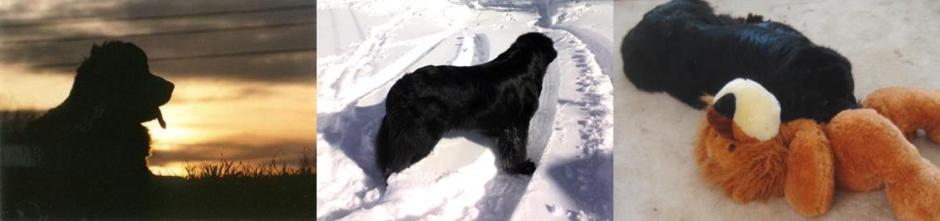
If I ever had brown Newfoundlands, there would be at least one “coffee litter”, with names such as Kaffe, Kona and  Kahlua, or “Jamaica” (call name “Jimmy”), “Columbian” (“Conny”) and Espresso (“Speedo”) – no Flying Monkeys please.  Banner could have easily been a Speedo – she doesn’t sleep much and has far more energy than the rest of us can keep up with.  However, I am a lot like Henry Ford when it comes to Newfoundlands; I love the deep shiny black coats.

Happy coffee-making.

Posted in Everyday | Tagged , , | Leave a comment

THE SUBARU BUCKET LIST COMMERCIAL

I’m not a fan of television ads, or internet ads, etc., generally, but I love this commercial – still!

I woke up this morning hearing Willie’s voice, but it kept morphing into another song:

You’re my buddy, my pal, my friend.
I’ll be with you until the end.
I’ll love you until
The rivers run still
And the four winds we know blow away.

(see Jud Strunkhttps://www.youtube.com/watch?v=g5AzmEX-txw)

You can’t go through old age with your Newf without feeling this, or missing them forever after.

When we moved into the cabin, I washed Parker’s frog and put it beside the bed, on my side.  It’s lovely to touch it’s softness, or once in a while, to do what Parker did and wrap your arms around it and feel that comfortableness that was present with him.  There is some silly new debate going on about whether dogs like hugs, but with the astute observation that not all dogs like hugs and you should check with the dog before assuming.  Parker gave warm hugs.  Holly loved to give hugs, from the time she was little, when she would reach her neck up as long as it would go, without climbing on you.  Most of my Newfs have given hugs.  Jade loves to give hugs, and when a hug is bestowed on you, it livens you inside.  Banner is doing this now too, when she can be still long enough.  ; )  And once in a while, she gets in that kind of mood, to indulge in being warm and sweet.

Parker’s frog has been the star of a couple of other commercials, so there are some occasional nice reminders too.  In one, at the senior phase of life, when the couple is camping in an open canvas tent in a remote tropical area, the lady wakes face-to-face with this large, happy-looking, plump green frog with a big yellow belly.  I thought the stuffed frog was created from fantasy colors, but that is him – real, slimy, but not soft and cushy.  I have a fondness for frogs and toads anyway, but this one is special.  It appears in another commercial as a ceramic figure.

Memories are very welcome, as that will have to do now.  Whether our needs ever transition such that we acquire a Subaru in place of our Newf limo (big van), this commercial has added to the lasting memories.

Posted in Communications - a two-way art, Final Departures (Loss), Seniors | Tagged , , , , , , , , | Leave a comment

“CAT” GOT YOUR TONGUE?

Here is an interesting, funny article on cat “language”:
https://www.theguardian.com/science/2016/mar/30/cat-got-your-tongue-scientists-pets-adopt-owners-accent?CMP=oth_b-aplnews_d-1

Doesn’t it make you wonder the same about dogs?  And what about non-verbal language?  My Newfs have each had different vocabularies (including body language), although there are some commonalities, such as the “Pfffsssshh!” as a Newf thinks a human takes f-o-r-e-v-e-r, or the sudden stop and stare when a Newf thinks a human gets it right (but is looking for some confirmation), or the Paw maneuver (“Oh, come on!  Let’s play.”) – and there are many others.

They don’t all go to the same school of etiquette, and they don’t arrive with the same styles, aptitudes and tendencies for a range of behaviors.  There is so much to minds and personalities that originates with genetics; we can shape and reshape, but a lot of it is there from the beginning, good, bad and funny.  So each Newf is an individual, and their uniqueness is what makes each learning process more interesting.  It would be quite comical for someone to take on a study of Newf language and provide an interpreter device.  In Banner’s case, there are many times when that would require a lot of “bleeping”.  <g>  Such as, when I take too long to put the collar over her head for a walk, or to open the door when she’s ready to go out.  Or to do most anything that requires patience – humans are soooo slow!  She eventually gave up on “cussing like a sailor” when we walk as she tries to “speed” in a “no passing zone”.  But you should have heard the complaint a couple of days ago about putting the collar on when she’s not in the mood for patience!  It makes you want to say, “Are those the same lips you kiss your mother with?”  <g>  Those deep low rumblings and growling would make someone unfamiliar with her freeze, with the hair on the back of their neck standing straight out.  However, she has no bad intention, she’s only verbalizing her complaint – her form of rude humor, SNL style.  It’s quite amusing, but I try to not react.  I don’t want to encourage it, but I hope it never completely disappears.

The two girls are polar opposites in many ways, but especially in their communication methods.  Jade is very quiet, similar to Banker, although there were times either of them will/would tell you what is/was on their minds.  You learn to pay attention, to watch their responses.  Banker invested in teaching me to watch and listen.  It was good preparation for when Jade arrived.  Banner is more like Parker in that she is very vocal and uses a wide range of vocalizations, but she’s the only one I’ve known who used her vocal capacities in this style.  And there are times when she can leave you speechless – make your jaw drop, figuratively speaking, and maybe even blush a little.   ; )

Posted in A Little Humor, Communications - a two-way art | Tagged , , , | Leave a comment

A CUP OF COFFEE

This morning I had a new lesson, and it brought up an old, fond memory.

I make my cup of coffee carefully.  It takes approximately 10 minutes to produce one cup.  It’s something that I sometimes go to bed looking forward to.  So, upon a carefully invested 10 minutes, the brew was finished, and cream was added.  Reaching to put away the second special ingredient, I bumped the mug.  Coffee, rich, brown, aromatic coffee, spilled all over the range and the floor, my sweats and shoes, the nearby cabinet doors with splatter that reached far and wide.  Banner was lying nearby, puzzled at the purpose of this change in the sequence of otherwise normal steps in a very routine process.  When I give the girls fresh water in the morning, I call it their “coffee”.  They seem to tolerate my confusion well.  Banner had no interest in *my* version of coffee, fortunately, as she doesn’t need any additional energy or momentum, on any day, but this was Friday, the arrival of Happy Days, the one that only occurs in one day out of 7.  She had already chased a cat, twice, and it was still early.

So, there lay my cup of coffee, spread across the floor.  I felt sorry for myself for a moment, needing the steam treatment of the coffee for added recovery from the respiratory infection earlier this week.  Then, in an instant, I had a memory of another spill episode.  It was many years ago, but one I won’t easily forget.  After getting home late, from working late, a hungry crew of four Newfs needed to have their dinner prepared.  Broccoli was on the menu, purchased in large bags, to feed all hungry Newfs.  I prefer to buy the broccoli in full stalks or florettes, but that brand tended to have a lot of loose small pieces of florettes.  I pulled the bag out of the freezer and when I opened the package, broccoli pieces and broccoli dust went everywhere!  Being very tired with no desire for delay or a crowd of volunteers offering to help, Banker must have read my expression with sympathy.  He wasn’t usually interested in frozen treats, but he looked at me sincerely, then gently came over and began picking up pieces and eating those.  He kept eating until, between the two of us, each piece had been picked up.  This may seem like a small thing, but it was a defining moment for the concept of friendship, for someone to quietly observe and offer to help with such gentleness and such genuine compassion.  In the moment that I saw him look at me and begin helping, my attitude was transformed from frustration to awe, and the problem was gone.

He didn’t show interest later in frozen treats either.  Any situation can have good lessons.  A couple of years later after a blueberry spill, when Parker offered to help, I learned about that very odd consequence of eating blueberries on a dog’s stool, after a fast trip to the vet, one where you pay for your veterinarian’s entertainment for the day.

This morning’s lesson:  I learned how to put the color back into brown suede house shoes that have been through the laundry a few times, and I enjoyed the reflection on how attitude shapes perception of problems and on the life-changing value of genuine friendship.  Some of my best friends are gone, and others are in the making.

It’s a good Friday.  Remember that adventure is where you find it, and enjoy the day!

Posted in A Little Humor, Communications - a two-way art, Diet & Nutrition, Lessons Learned | Tagged , , , , , , , , , , , , , , | Leave a comment